"Men will always be necessary to defend our country" Interview by Stephen Montety
of Le Figaro of 11/07/2008
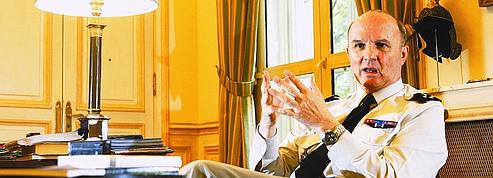
"As a member of the Security Council, France can not avoid its responsibilities when the world order is being undermined "said General Jean-Louis Georgelin on the tasks entrusted to the French military.

(photo Francois Bouchon / Le Figaro)
In the occasion of July 14, General Jean-Louis Georgelin, Chief of Defence Staff speaks. Deliberately choosing not to comment on recent events, he reflects on the status of a soldier at a time when high technology invaded the world of defense and security.
LE FIGARO. - The first question concerns the moral and intellectual forces now that our country has not experienced war for half a century. What light is there on his army?
Jean-Louis Georgelin. - I see that this look is positive in view of all the polls we have. Not the image of the armed as measured in these surveys has been good in recent years, while paradoxically the concept of war has deserted the minds. This probably reflects the fact that people feel a strong need for security against threats to the territory.
You are the Chief of Army Staff who have experienced during the twentieth century several defeats. The recollection of these episodes he leads a lack of credibility of the French armies, especially in the eyes of the foreigner?
I'm not at all feel that the losses you mention hanging over us. Military history is still a succession of victories and defeats. The Americans, for example, have won extraordinary victories at the end of the Second World War, but they have known since Vietnam. It is true that the French army symbolically weighed the 1940 defeat, felt like a real humiliation, and Indochina, where we could measure the separation between the CEF and the country, and finally Algeria where there was a real tension between the military and political leaders. Personally, I remain deeply affected by the defeat of 1940, about which we have not yet exhausted, as evidenced by reading The Strange Defeat, Marc Bloch, important book that I always read to my subordinates.
Today, youth officers, the past fades, even if only because these events date back almost seventy years. Today is another type of war. Your question suggests that there may be complex with regard to this story. The answer is no. First, because the recent works of historians rehabilitate how the French fought in 1940. The debacle has not prevented individual behaviors consistent with military honor. France has been present to victory in 1944 and 1945. Finally, since the end of the war in Algeria, she has led a number of military operations in Africa or elsewhere, and each time she has demonstrated a real military capability, which means that our image abroad n has steadily increased.
1870, 1914, 1940 ... It seems there is a kind of inevitability that makes the French army is always behind a conflict ...
In defeat, the responsibility of the military is not unique. They share with political leaders who took strategic options and budget, and with the nation itself. The historian Jean-Baptiste Duroselle did analyze the difference between diplomacy and military tool. But it also shows that there must be total coherence between the two. For there is a difficulty that we face all the time: calendars. The duration of construction of a military tool does not match the speed with which one can change the concept of diplomatic or political vision. Can evolve a policy a few years, but a military tool is built into thirty or forty years. We just change the world with the demise of the Warsaw Pact, and in France, the professionalization of the army. But this is not a reason to liquidate all equipment we had: we could see the role of artillery in the siege of Sarajevo, the Leclerc tank in Lebanon. Generally, in peacetime, there has always criticized the military to be too expensive.
For Westerners, the only legitimate military intervention that is based on international mandates, not to defend the national interest but to restore the rule of law in foreign lands. Is there more soldiers, but policemen of the international order?
History of France being what it is, especially as a member of the Security Council, it seems difficult for her to discharge of its responsibilities when the world order is being undermined. Often I am asked: "Dying for Kabul, what does that mean?" This means that the soldier is a servant who obeys the mission given to it. That the President of the Republic to assess the merits of the mission. But our society tends to lose the notion of obedience, which requires discipline and humility. The army, after that company is not immune to such a drift. Obey, it means that we recognize an authority is superior, that our time is extremely relativistic, is hard to accept.
We can also ask whether the concept of war itself is exceeded, which would mean the end of the soldier. For my part, I do not believe that, whatever the wisdom of men, we can say that the war has disappeared. Especially because a level of wealth as that of Europe will sooner or later coveted, especially if America remains an island of prosperity surrounded by a poor world. The French nation will she able to endure another war? Yes, if she has kept within its borders, as part of its alliances, women and strong men of a spirit of sacrifice and renunciation, which have accepted a life of selflessness, willingness to take risks. I often think that speech which Thucydides puts into the mouth of Pericles eulogizing dead fighters against Sparta: "There is no happiness without freedom and there is no freedom without courage." We must not forget that reality.
What does the ideal military in 2008?
One of my concerns is the risk of trivializing the military. With the prospect of a difficult international situation, we should commit ourselves to a large scale in a hard conflict, my concern is to have the military really ready to meet state requirements military. When I met the Chiefs of Staff, is a theme that I discuss often. We must always be ready to face a serious event, and could exceed the current framework of our overseas operations. For me, the duty of a leader is to get that attitude and maintain. Officers in schools, identifying students strikes me. It should not be that over time this feeling fade. Let me make a comparison in the religious sphere: there are religious in countries where it is carried by a true faith. A country that is no longer concerned for his safety, but only by concerns individual would be endangered.
These young people are trained to an ideal based on the notion of sacrifice. What does this concept today as officers of the army have been largely dead since the end of the war in Algeria?
We had since the end of the war in Algeria for more than six hundred dead in the theater of operations. We were dead in Lebanon, Bosnia, Chad, Côte d'Ivoire, Afghanistan. But our young officers should not be mistaken in time and live in nostalgia of RC4. We must be prepared to die if freedom of the City requires. We can not exclude the spirit today sacrifice in the training we provide. An army that would give up this spirit of sacrifice becomes a simple international police. We can not ignore the fact that the true specificity and true nobility of the military profession. An army who would give up an army.
We have a small army. Is it reasonable to think that she should make the management of conflicts of low intensity, maintaining order throughout the year? Can both do that and be prepared for more serious events?
is my responsibility to be able to do so. I currently under my orders 250 000 soldiers. We must both be able to participate in these operations while continuing to train and we train ourselves. I always wonder when I hear explain that France should intervene in some operations: it is often the international situation that dictates the operations in which we must get involved. We do not always have a choice. The French army must be possible in three directions: to cope with a sudden worsening international situation, fight against instability in the framework of our international commitments, to participate in protecting our interests and our citizens including in civil operations in the country, as in natural disasters, for example. It would be wrong to believe that we can favor one of these areas to the detriment of the other two.
The mission of the military is not unconnected with the police officer, even if it does not question the collective destiny of the nation and works within the national framework to preserve the rule of law . But can we differentiate between these two states?
There is a fundamental difference between the police and the military even if it is true, the two risk their lives in the exercise of their profession: the nature of the adversary. The opponent is the police that an offender must neutralize the name of the company; the soldier is a man who, like him, is in charge of the destiny of his nation and fought for his country. In the latter case, the level of violence may reach an extreme stage.
But for twenty years, the French armies are engaged in outside a crackdown on offenders under international law ...
I do not deny the fact that indeed we are dealing with some kind of offenders. But the difference is that they rarely act for its own interests but in the name of a certain collective vision, which gives them ideal and perseverance in action.
Do you feel today that the military thinks about itself, it produces a thought to design or plan? The Centurions Are some doctors?
is often the case against the French military thinking. It is also a consequence of our defeats. We forget that a number of our military thinkers have still abroad. Do you know Guibert, Captain Ardant du Pic Admiral Castex, who is recognized and studied in the U.S.? In the 1960s, we also had two types of thinkers French soldiers: experts the Revolutionary War, David Galula (the thinker of the cons-long insurgency published in the U.S. and arrives just in France), Colonel Trinquier. Other soldiers were a true reflection on the nuclear era, generals Beauffre and Welsh and, of course, Lucien Poirier.
So it's true, France is written under the United States. But I note with satisfaction that this is changing. Recently, several scholarly works, analysis of the history, strategy were published by colonels. We naturally encourage officers to publish, through CEREM (Centre for Studies and search of higher military education) or the journal Inflections. It also created the DSMB (Centre Joint concepts, doctrines and experiments), which reflects in depth on all these subjects, also with the doctrine centers of each army.
Reflection is difficult because, unlike fifty years ago, the threat is more diffuse
... Precisely because the situation is more difficult than the reflection is even more necessary. Reflection, especially through writing, is conducive to the man of action to prevent it from slipping. Consider what? It seems important to think constantly of what the war today. What does that mean in a country in Europe that has postponed the threat beyond its borders, new situation, which closed the open parenthesis of conscription by the French Revolution? What is war today? What kind of conflicts should you prepare, when the technology (including information technology and communication) have significantly changed? We must take advantage of opportunities offered by technology, but believe that we can protect our society without taking risks is a dangerous illusion. To be respected, we must take risks humans. Look at the plight of Americans in Iraq. We saw them destroy the army of Saddam Hussein in three weeks. Four years later, they are in an extremely difficult situation. War is not a pure rational world. Take the concept of courage. In all societies, it is a virtue. And yet ... As long as one is not tested, we know nothing of courage. Courage can be individual or collective. I'm always fascinated by the reaction of Margaret Thatcher during the Falklands War. What justified going to war for a few islands lost, if not honor and courage in command to take risks? The idea that only by cameras, satellites, sophisticated weapons we will be defended against all is an illusion. If I am a soldier, because I think that there must be men and women to defend our country, our values, what we believe. This dimension has been fully taken into account in the White Paper.